الذكاء الاصطناعي والأتمتة (AI / Automation)
Dawrak — Aid Management & Distribution Automation
An Arabic-first platform for managing aid applications and distribution workflows for charitable organizations. Dawrak combines a responsive citizen portal, a staff dashboard, and n8n-powered automation. Features include application tracking, human review and approval, stock allocation, pickup scheduling, and duplicate-protected delivery records. Role-based access and an audit trail support accountable operations, while nine automation workflows handle application processing, reminders, and reports. Built with Python, PostgreSQL, and Docker Compose. Currently an early prototype for local evaluation, with external notifications simulated.
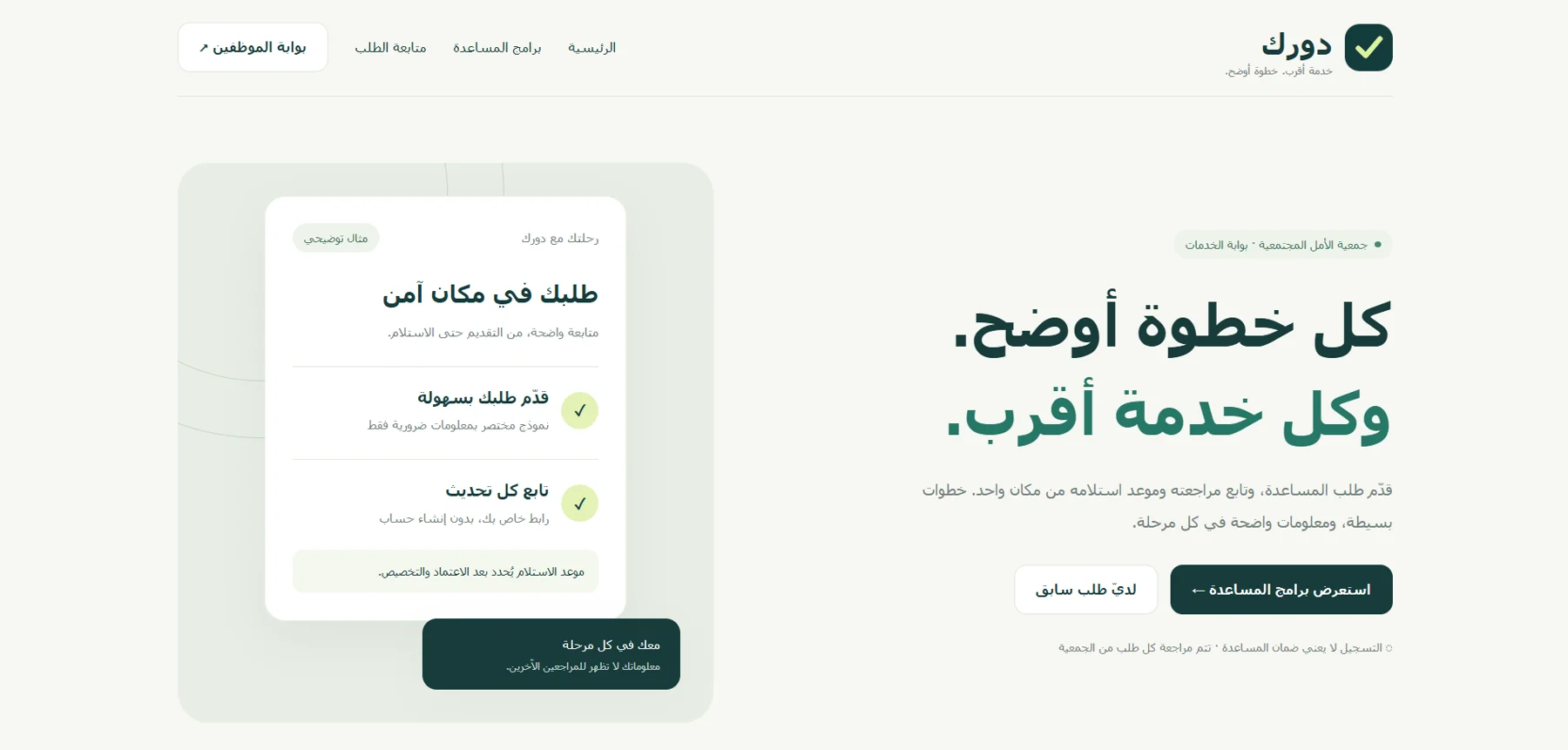
Dawrak — Aid Management and Distribution Automation
Project Overview
Dawrak is an Arabic-first prototype designed to help charitable organizations manage the aid lifecycle, from application submission and review to stock allocation, pickup scheduling, and delivery recording. It combines a citizen portal, a staff dashboard, and n8n automation workflows.
The Challenge
When applications are spread across messages, spreadsheets, and manual records, tracking each request becomes difficult. Applicants may need to ask repeatedly for updates, while staff must consult multiple sources to understand decisions, available stock, and distribution schedules.
The project explores a practical question: how can these activities become one clear workflow while keeping eligibility decisions with authorized staff?
The Solution
A platform that brings applications, decisions, inventory, and appointments into a single database. Applicants receive a private tracking link, while staff use role-based dashboards for review, approval, and distribution.
Following human approval, automation attempts to reserve aid and schedule collection according to available stock and appointment capacity. If resources are unavailable, the application remains approved but awaiting allocation, without promising an unconfirmed pickup.
User Experience
• A responsive Arabic RTL interface with a calm visual design.
• A three-step application flow: requirements, information, and review.
• Private tracking of application status, missing information, and pickup details.
• Follow-up submissions, complaints, and access to the organization’s responses.
• Staff views for applications, inventory, appointments, and automation status.
Technical Architecture
The frontend uses HTML, CSS, and JavaScript, supported by a Python backend and a Docker-based PostgreSQL configuration. n8n schedules and coordinates processes through a protected internal API.
The package includes nine automation workflows covering application intake, actions following human decisions, information updates, delivery follow-up, complaints, reminders, and daily reports.
Engineering Decisions
• A Transactional Outbox stores each application and its associated event in the same transaction, preventing event loss if automation becomes unavailable.
• Idempotent event processing helps prevent duplicate effects during retries.
• Atomic database transactions reserve stock and appointment capacity together.
• A database constraint prevents duplicate delivery records for the same allocation.
• Application status is separated from allocation and delivery status.
• An audit trail records administrative decisions and actions.
Privacy and Access Control
The prototype provides administrator, reviewer, and distribution staff roles. Distribution staff are restricted to their assigned center. Citizen access relies on a random tracking token whose hash is stored in the database, while tracking responses expose only the information needed to follow the request.
The system does not use AI to determine eligibility, and submitting an application does not guarantee assistance.
Results and Validation
An initial implementation was built with the core application lifecycle, Docker Compose configuration, and n8n workflow files. Application logic passed 20 tests using a SQLite test adapter, including concurrency, duplicate delivery prevention, authorization, and event retries. A synthetic application was also submitted through a browser, successfully generating a receipt and tracking link.
No field outcomes, such as reduced waiting or processing time, have been measured yet. PostgreSQL and n8n execution within Docker still require end-to-end validation in the target environment. External notifications are currently simulated rather than delivered.
Next Steps
Pilot the platform with one organization, validate the Docker-based workflow end to end, and refine the experience using staff and applicant feedback. Priorities include integrating a real messaging provider, improving exception handling and data retention, and completing security and deployment preparation before real-world use.